
|
#978 (3/19/26)
|
|
|
BY TONY FOURNIER |
|
This article is about Red Robin Records, located in Harlem, New York City. Bobby Robinson had a record store which opened in 1946, named "Bobby's Record Shop", near the Apollo Theatre. As talent was nearby and accessible, it was a good business decision to start a record company.
Red Robin Records was formed by brothers Bobby and Danny Robinson in November 1951. The label produced about 40 releases, more than half of which were vocal group records, before closing in 1956. After Red Robin, Bobby Robinson formed the Whirlin Disc* (1956-1957), Fury (1957-1959), Fire (1959-1962), and Enjoy (1962-1985) labels. (*Jerry Blaine of Jubilee Records was co-owner.) |
BOBBY ROBINSON

|
Above: Photo of Bobby Robinson.

|
Above: NEW YORK AGE, December 24, 1949.
NOTE: A last minute Christmas gift idea.

|
|

|

|
Above: Photos of Bobby's Record Shop using new names, circa 1960s. Note the speaker in front of the store in the above left photo. Bobby, in the photo above right, would play records into the street to draw customers into the store.

|
Above: Robin Records flyer, probably from December 1951. (Thanks to Marv Goldberg)
If "Robin 101" at the top is meant for the Mello-Moods' record, it should be Robin 105.
"Freddy Jackson" should be "Freddie Jackson".
MORRIS LANE AND BAND

|

|

|

|
Above Left: Label image of Robin 101 reissued as Red Robin 101. Robin Records in Tennessee reportedly forced Bobby Robinson to change his label name. There was a small, short-lived "Robin" label located in Nashville, Tennessee, but that was in the 1960s or later. Interestingly, per ARLD Dating Guide, there was also a Red Robin label active in Nashville in circa 1952. This label was owned by Jim Bulleit, who was well established in the record industry (Bullet, Delta, Village labels). Bulleit changed the Red Robin name to J-B Records in circa October 1952.
Above Right: NEW YORK AGE, December 17, 1949.
NOTE: Baby Grand Cafe is not far from Bobby's Record Shop, located on the same street. A very nice lineup of talent indeed!
CHICAGO DEFENDER, July 12, 1947:
NEW YORK—Kay Kayser may be known as the "Professor of Musical Knowledge", but Lionel Hampton is the "Professor of Musical Development" for, on his search, he goes for the best there is in the way of musical talent.Just recently he hit upon the idea that the solution of the "Re-bop" and "Be-bop" controversy might be solved by adding the "Be-bop" King Morris Lane, famous tenor saxophonist.
CASH BOX, November 7, 1953:
....Good to see Morris Lane and his big horn back in Harlem town after dates in Chicago & vicinity....

|

|
CHARLIE SINGLETON ORCHESTRA

|
Above: Photo of Charlie Singleton, who grew up in Kansas City, but moved to New York City at the start of his career. He was an alto and tenor saxophone player, bandleader, and songwriter. He was also an A&R man for Herald Records in New York City. Charlie had records on Apollo, Star, Lee, Saturn, Faith, Decca, Robin, and Atlas.

|

|
NOTE: Some websites state that Robin 102 is "Good Morning To Heaven"/"Is He Yours" by the Robert Rose Singers. No conclusive evidence has been found to confirm that. If anyone has Robin 102, please send me label scans (and audio files if possible).
Above: Label image of Robin 103-A, released in late 1951. The vocal on the top side is by Freddie Jackson, who also composed the song. The flip-side, "Earthquake", is an instrumental. This is Charlie's only record on the Robin or Red Robin label. Freddie and Charlie had been with the Joey Thomas Orchestra on the Decca label earlier in 1951. And before that, Freddie was vocalist for Charlie Singleton's Orchestra on Decca.LISTEN (Windows Media Player):
1. "Never Trust A Woman" - Charlie Singleton And His Orchestra (Vocal By Freddie Jackson) - Robin 103-A - 1952.
2. "Earthquake (Instrumental)" - Charlie Singleton And His Orchestra - Robin 103-B - 1952.BOTH SONGS played in sequence.
At Right: FORT PIERCE NEWS-TRIBUNE (Fort Pierce, Florida), November 30, 1952.
NOTE: Charlie was with ATLAS RECORDS at the time of this appearance notice.CASH BOX, June 7, 1952:
....Rainbow Records announced it's entry into the Rhythm and Blues field. The new releases will carry a yellow label with blue printing. Floyd Williams, alto saxation, and his band have waxed "Creepin' In" and "Jambo Jump" for the first Rainbow issue under the new label. Teddy McRae and Charlie Singleton are doing the A&R work for the disker....

|
Above: CHICAGO DEFENDER, August 5, 1950: MOVIE STAR ON PROGRAM — Eugene Jackson, right, for years a star in various Hollywood pictures and now on tour with his own trio, will be one of the artists appearing in the Billiken Parade.
Here, Jackson is shown with, left, Freddie Jackson, and Frank White, the other members of his aggregation, currently appearing in one of Chicago's exclusive Northside cafes.
CALIFORNIA EAGLE, November 7, 1946:
The Jackson Trio, now appearing nightly at the Tavern Club in Westwood Village, continued their climb to success when they played a one-night stand in San Diego last week...The up-and-coming trio broke all records for a musical unit of its size and were offered two return engagements. The Jackson Trio features Eugene Jackson on tenor sax, Freddie Jackson, drummer, and Virgil Johnson, pianist.
CALIFORNIA EAGLE, January 16, 1947:
The famed Jackson Trio move into the Florentine Gardens on January 23.... Billed for many more recordings which have made them widely known, the Jackson Trio's current waxings on the Courtney label are "You're My Breakdown" and "Voote".The Trio close a 6 weeks engagement at the Carmell Hotel in Santa Monica on January 22.
(NOTE: Freddie and Eugene were brothers. In vaudeville, they were known as the Jackson Brothers. Freddie, earlier known as "Freddie Baker", also had been a film actor.)
EXTRA RECORDS — CHARLIE SINGLETON

|

|
Above Left: Label image of Star 719, released in 1950. No information or photo was found for the vocalist, Linwood Sutton. Both Star and Lee were New York City labels. Above Right: Label image of Lee 208, released in 1950. The labels for both sides of both above records show "Singleton" as the songwriter, except "Please Don't Leave Me Here To Cry" adds "Vaughn". Jake Vaughn was named "The Great Blues Singing Master Of Ceremonies". The labels do not show "BMI", nor are any of the four songs registered there.
LISTEN (Windows Media Player):
1. "Hard Times Are Coming" - Charlie Singleton Orchestra (Vocal By Linwood Sutton) - Star 719 - 1950.
2. "Camel Walkin'" - Charlie Singleton Orchestra (Vocal By Linwood Sutton) - Star 719 - 1950.
3. "S.O.S. (Instrumental)" - Charlie Singleton Band - Lee 208 - 1950.
4. "Please Don't Leave Me Here To Cry" - Charlie Singleton Band (Vocal By Jake Vaughn) - Lee 208 - 1950.ALL FOUR SONGS played in sequence.

|

|
|
AUDIO NOT AVAILABLE AT THIS TIME:
1. You Sure Been Good To Me - Charlie Singleton Band (Vocal By Freddie Jackson) - Faith 238 - 1951. 2. I Know - Charlie Singleton Band (Vocal By Freddie Jackson) - Faith 238 - 1951. |

|

|
Above Left: THE DAY (New London, Connecticut), October 6, 1950. Above Right: STATEN ISLAND ADVANCE, August 20, 1954.

|
Above: THE DAY (New London, Connecticut), October 31, 1953.
THE MELLO-MOODS

|
Above: Photo of The Mello-Moods, (Back L-R) Jimmy Bethea (bass), Bobby Baylor (tenor and baritone), (Front L-R) Monte Owens (tenor, baritone, and guitar), Ray "Buddy" Wooten (lead tenor), and Bobby Williams (second tenor and piano). The two Bobby's and Monte later joined in forming The Solitaires. It was Bobby Robinson who gave them their name, The Mello-Moods. All the members were very young at the time of this record, ranging from 12 to 16 years old. Yet their songs were aimed at a mature audience.
The Mello-Moods had two records on Robin/Red Robin (1951-1952) and two more on the Prestige label (1953). They had a very nice sound, too bad there weren't more records by them.
THE MELLO-MOODS WERE INDUCTED INTO THE UGHA (UNITED IN GROUP HARMONY ASSOCIATION) HALL OF FAME ON 4/24/99!
Click HERE for an article about The Mello-Moods by Marv Goldberg. (Will open in a separate window)
|

|
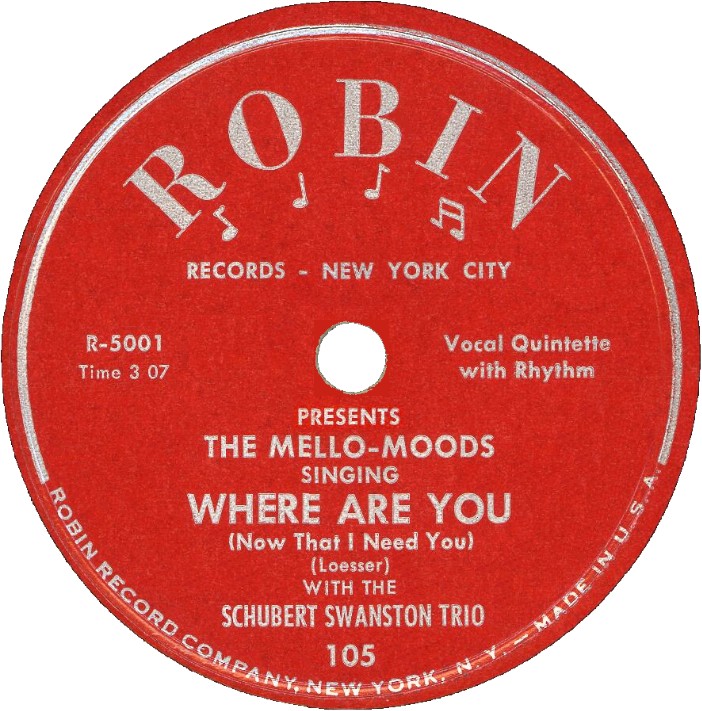
Above Left: Label image of Robin 105, recorded and released in December 1951. "Where Are You" is a Frank Loesser song released by several popular singers in 1949, including Betty Hutton, Doris Day, and Frankie Laine. The flip-side, "How Could You?", was written by Joel Turnero, who was the group's manager. Buddy Wooten sings lead and Bobby Williams second lead on all four of the above sides.
Above Right: Label image of Red Robin 104, released in 1952. Although this record has a lower number, it was recorded and released in 1952, later than Robin 105. Robin Records has now become "Red Robin" and Robin Record Company is now "Robinson Record Corporation".
The group members on this record are the same personnel as listed further above, except Bobby Baylor had left the group.
The flip-side, "I Couldn't Sleep A Wink Last Night", is another oldie, popularized by Frank Sinatra in 1943. The label doesn't name the instrumental combo, but Schubert Swanston, along with Joel Turnero, are composers of the shown side.
At Direct Right: THE BILLBOARD, February 16, 1952. "THE MELLOW MOODS" [sic].
CASH BOX REVIEW (1/12/52):
THE MELLO-MOODS — ROBIN 105
Where Are You/How Could You?
An oldie is given a new lift, rhythm and blues style, by the singing Mello-Moods. With an echo chamber affect and the backing of the Schubert Swanston trio, this lid can make noise. The under level is similar to the top side in treatment and it too sounds good. We think it's the upper half.LISTEN (Windows Media Player):
1. "Where Are You" - The Mello-Moods - Robin 105 - 1951.
2. "How Could You?" - The Mello-Moods - Robin 105 - 1951.
3. "And You Just Can't Go Through Life Alone" - The Mello-Moods - Red Robin 104 - 1952.
4. "I Couldn't Sleep A Wink Last Night" - The Mello-Moods - Red Robin 104 - 1952.ALL FOUR SONGS played in sequence.


|
Above: TRADE MAGAZINE, February 1952. "THE MELLOW MOODS" [sic]. CASH BOX, January 12, 1952:
DEMAND FORCES JUBILEE TO SHIP BY AIR
NEW YORK—Jubilee Records is currently so hot with its releases that Jerry Blaine, president of the firm, has revealed that he is being forced to ship copies to the midwest by air.The three disks which are causing all the commotion are "Baby Please Don't Go" with the Orioles, "Diane" by Buddy Lucas, and "Where Are You" by the Mellow Moods [sic] on the Robin label. The unprecedented demand has Jubilee disks climbing fast on all the charts.
EXTRA RECORDS — THE MELLO MOODS

|

|

|
Above Left: Label image of Prestige 799, recorded in November 1952 and released in January 1953. The group's personnel on Prestige is the same as was on their second Red Robin release. Both sides were composed by Joel Turnero and Schubert Swanston, who you'll recall was head of the combo that backed The Mello-Moods on the Robin label.
Above Middle: CASH BOX, March 7, 1953.
Above Right: Label image of Prestige 856, recorded in the same November 6, 1952 session and released later in 1953. This ended The Mello Moods' short recording career.
"I'm Lost" was written by Otis René, owner of Excelsior Records. It was a hit for the King Cole Trio on the Excelsior label in 1944. Benny Carter's Orchestra also had a hit with the song on Capitol in 1944.
The flip-side, "When I Woke Up This Morning", is the third side composed by Turnero-Swanston for "The Mello Moods" on their two Prestige releases.
CASH BOX, November 29, 1952:
....Mellow Moods [sic], formerly with Robin Records, signed to Par label....
NOTE: Par was affiliated with Prestige Records.LISTEN (Windows Media Player):
1. "Call On Me" - Mello Moods - Prestige 799 - 1953.
2. "I Tried, And Tried And Tried" - Mello Moods - Prestige 799 - 1953.
3. "I'm Lost" - The Mello Moods - Prestige 856 - 1953.
4. "When I Woke Up This Morning" - The Mello Moods - Prestige 856 - 1953.ALL FOUR SONGS played in sequence.

ABOVE: CASH BOX — MARCH 20, 1954
SPOTLIGHT ON JOEL TURNERO

|
Above: Photo of The Midnighters, from March 1955, with their trophy for Cash Box's "Best R&B Vocal Group Of 1954". (L-R) Henry Booth, Lawson Smith, Sonny Woods, Joel Turnero (in dark jacket), Cal Green (their guitarist), and Hank Ballard.
Turnero, Cash Box columnist, holds the group's gold record from Federal for "Work With Me Annie". He was not a member of The Midnighters.
Joel Turnero was a record producer, artist manager, songwriter, columnist, and radio disc jockey. He was a man about town in the rhythm and blues field in New York City. He was also a close friend to Bobby Robinson of Red Robin Records.
Click HERE for an article about Joel Turnero by Charlie Horner. (Will open in a separate window)

|
|

|
Above: NEW PITTSBURGH COURIER, November 13, 1954:
The opening of Flapps [sic, After Hours] Record Shop in Harlem last week got the real Hollywood-style premiere treatment when a crowd of the nation's record stars showed to wish the business well.Among the glad-handers were (front row, left to right) tenor saxman Lucky Thompson, fight champ Archie Moore, owner Flap Hanford, Ruth Brown, jazz star Willis Jackson, and (back row) Joe Holiday, sax star; Joel Turnero, columnist for Cashbox magazine; Monte Bruce, prexy of Bruce Records; and Willie Winfield, leader of the Harptones.

|
|
CASH BOX, May 1, 1954:
....And from the heart of Harlem comes the news that another new diskery will preview its first releases next week. The name of the new firm will be "After Hours Record Company". First release features the sparkling new vocal quintette who answer to the name of The Vibranaires who for many a season have been winning many a friend via public appearances in the areas of New York, New Jersey, Philadelphia, and Connecticut. President of the label is successful uptown business man Lexy "Flap" Handford....CASH BOX, May 8, 1954:
....Energetic busy body of the Portem [Distributors, New York City] lineup, Joe Grippo, sat in on the first of the sessions in the wax room conducted by the new "After Hours" diskery and nodded time and time again his approval of the whole happenings which will introduce one of the most exciting new vocal groups currently gracing the nation's cabaret and show place floor's, "The Vibranaires"....
CASH BOX, July 3, 1954:
....In again out again quick and quiet like eased the hardhitting Swallows to swing-sing a few for the newly formed After Hours Record Company staff-men, who lost no time in releasing pronto their first twosome entitled "My Baby" and "Good Time Girds". Those who chanced to hear the first few air plays of these pressings say that they possess all the good commercial gimmicks which are needed to net the big money....CASH BOX, August 7, 1954:
....Here's a scoop. This week Lexy "Flap" Hanford, prexy of the newly formed Chariot and After Hours diskerys, and dee-jay writer Joel Turnero swing open the doors to one of the nation's most unique, well stocked, well equipped retail record shops.Negotiations are already near completion for Joel to broadcast his groovy show, spotlighting "Sure-Shots" from Cash Box, from the window of this ultra modern little shop which sits directly on the corner of 125th Street and 7th Avenue....
At Direct Right: CASH BOX, September 11, 1954: "GOOD NEWS SWEETHEART"
CHICAGO—Following a recent Spaniels session, the group gathered in the office of Jimmy Bracken, president of Vee-Jay Records, to check their latest recording, "Good Night Sweetheart", in the Cash Box charts.From left to right we see The Spaniels, in white; Calvin Carter, manager of the group and brother of Vivian Carter (Mrs. Jimmy Bracken) and WWCA-Gary, Indiana, disk jockey whose picture is on the desk; Jimmy Bracken; Joel Turnero, disk jockey and New York retail record shop owner; and Paul Gill, R & B department of James H. Martin, Chicago distributor.


|

|

|

|

|
Above Left: Photo of The Vibranaires from 1956. (Top L-R) Roosevelt McDuffie, Bobby Thomas, Lenny Welch, (Bottom L-R) William Penha, and Joe Major. [Photo is courtesy of Jean-Christophe Piazza] Above Middle: ASBURY PARK PRESS, December 17, 1954.
NOTE: The Vibranaires (Vibes) were from Asbury Park, New Jersey.Above Right: Photo of yours truly with Bobby Thomas, taken at a UGHA concert in 1998. Note the record label on my t-shirt. Two people who, it seemed to me, stayed young forever were Earl Lewis of The Channels and Bobby Thomas.
ASBURY PARK PRESS, March 12, 1953: TEENAGE VOCALISTS COP TALENT PRIZE
ASBURY PARK—....First place winner in the initial night of competition of Savoy Theater's 10-week talent program were "The Vibranaires", a teenage male quintet. They were awarded a $25 war bond.ASBURY PARK PRESS, April 24, 1953: SEVEN FINALISTS TO VIE FOR TLEVISION SET
ASBURY PARK—....Seven finalists in the Strauss Store Talent Contest will compete for a $200 TV set Saturday night at the Savoy Theater, Bangs Avenue. The final contest will start about 8:30 P.M. The finalists include....The Vibranaires.... Audience reaction will determine the winner.

|

|
TWO GOSPEL KEYS

|
Above: The Two Gospel Keys, from Augusta, Georgia, were an American 1940's/1950's gospel duo with Emma Daniels singing with guitar and Mother Sally Jones singing with tambourine. In addition to the Red Robin label, they had records on Disc (1946-1947), Apollo (1947-1949), and Solo (1949).

|
|
RED PRYSOCK

|
Above: Red Prysock, from North Carolina, was a tenor saxophonist, bandleader, and songwriter. He began his career with Tiny Grimes And His Rocking Highlanders in the late 1940s. Red then moved to the Tiny Bradshaw, Roy Milton, and Cootie William bands. His first record, as a bandleader, was on the Red Robin label in 1952. In 1954, he signed with Mercury Records. From 1954 through 1960, he had at least eleven releases on the Mercury label, plus some releases on Wing, a Mercury subsidiary label. His biggest hit was "Hand Clappin'", issued on Mercury in 1955.
Red and his band backed up his brother, popular singer Arthur Prysock, on some of Arthur's hit records.
At Direct Right: STAR LEDGER (Newark, New Jersey), May 20, 1955.
NOTE: The referenced "Rock 'N Roll" is a record that Red Prysock had released on Mercury in early 1955.SANFORD HERALD, July 30, 1955:
UNTIL SEVEN YEARS ago, sax star Red Prysock....never had any idea of becoming a musician. In 1948, however, while a member of the armed forces stationed in Germany and with time on his hands, he bought a second-hand sax. Within six months he had progressed to a point where he was asked to join the army band stationed in Germany.Three years later, after his army discharge, he realized playing his horn was the desire of his life. He organized his own band and has been on his way with such recording hits as "Soft", which he wrote with bandleader Tiny Bradshaw, "Jump Red Jump", "Crying My Heart Out", "Hey There", and "Rock 'N' Roll".
(NOTE 1: The above blurb leaves out an important gap between 1951 to 1954.)
(NOTE 2: "Soft", released in 1952, was while Red was still playing tenor sax Tiny Bradshaw's band. "Crying My Heart Out" is his first record on the Red Robin label. "Hand Clappin'" was recorded just three weeks before the July 30, 1955 edition of the Sanford Herald was published.)


|

|
Above Left: Label image of Red Robin 108, released in 1952. This is the first of three records that Red Prysock had on Red Robin, the last in 1955. Per the matrix numbers, they were recorded in three different sessions. Makes you wonder if Red and his crew stopped by to see Bobby Robinson whenever they were in town, perhaps performing at the Apollo Theatre in Harlem. The labels for both sides credit "Prysock" as composer. However, BMI.com credits Wilburt Prysock (aka Red Prysock) and Morgan C. Robinson (aka Bobby Robinson) for "Wiggles". The flip-side, "Crying My Heart Out", is not listed at BMI.com. Did Red (and other Red Robin artists) ever realize that Bobby was taking credit for their songs?
Above Right: Label image of Red Robin 116, released in 1953. Both sides show "Prysock" as the songwriter, BMI.com lists neither song. The 45-rpm version has a one-word title, "Hardrock", but that's not registered at BMI.com either.
Was the flip-side, "Jump For George", intended as a disk jockey record? If so, then for who? Could it have been George Lorenz, who did a "rock and roll" radio show which was broadcast from Buffalo, New York, on powerful 50,000 watt WKBW.
Lorenz's show was heard by many in the New York City area, including me. Interestingly, he had the same theme song that Alan Freed used on WINS in New York City, Cozy Eggleston's "Big Heavy".
At Far Right: Gale Booking Agency publicity photo of Red Prysock (And Orchestra).
LISTEN (Windows Media Player):
1. "Wiggles (Instrumental)" - Red Prysock And His House Rockers - Red Robin 107 - 1952.
2. "Crying My Heart Out (Instrumental)" - Red Prysock And His House Rockers - Red Robin 107 - 1952.
3. "Hard Rock (Instrumental)" - Red Prysock And His House Rockers - Red Robin 117 - 1953.
4. "Jump For George (Instrumental)" - Red Prysock And His House Rockers - Red Robin 117 - 1953.ALL FOUR SONGS played in sequence.

EXTRA RECORD — RED PRYSOCK

|
Above: Photo of Red Prysock

At Left: The Billboard (1/29/55). In the full page clipping, Alan Freed thanks Red Prysock and the other artists who performed in his first "Rock 'n Roll" party stage show at St. Nicholas Arena in New York City.
It also states there were "Over 15,000 paid admissions... Greatest advance sale in the history of American dance promotions. Thousands turned away."
ALAN FREED'S WINS RADIO SHOWS:
Alan Freed would begin his radio shows with an instrumental selection. The following is from his February 12, 1955 "Rock And Roll Party - Number One" aired on WINS, New York City, 1010 on your dial. It was a Saturday and that meant a "Top 25 Countdown"."Rock 'N Roll" by Red Prysock was the first song played on this show as a "warm-up" before starting the countdown.
Alan Freed sings along (even though there are no lyrics) and pounds a telephone book to emphasize the heavy beat.
Here it is (1) from the Alan Freed Show and (2) directly from the record....
LISTEN (Windows Media Player):
1. "Rock 'N Roll (Instrumental)" - Red Prysock Orchestra - Alan Freed Rock And Roll Party (February 12, 1955).
2. "Rock 'N Roll (Instrumental)" - Red Prysock Orchestra - Mercury 70540 - 1955.BOTH SELECTIONS played in sequence.
By the way, Red Prysock also had a record titled "Rock And Roll Party" issued on Mercury in 1956. The flip is "Rock And Roll Mambo", but we won't go there.
The Billboard (11/12/55):
"Based on an actual vote of rhythm and blues disk jockeys (regardless of most played status) for the period covering January 1, 1955 thru October 8, 1955," Red Prysock took first place in The Billboard 1955 Disk Jockey Poll for "Favorite R&B Instrumental Group or Band".A extensive six-part article about Alan Freed is at Chronological History OF Alan Freed In Newsprint. The article also includes a link to "Alan Freed Radio Shows From WJW (Cleveland) and WINS (New York City).

Above: BALTIMORE AFRO-AMERICAN, January 30, 1954.
NOTE: Just like Red Prysock, Big John Greer was a bandleader and tenor saxophonist. Red looks very young in this photo.Red was the saxophonist in Tiny Bradshaw's band for "Heavy Juice". The composers of that song (per BMI.com) are "Myron C. (Tiny) Bradshaw", "Leroy Bass", and "Wilbur Prysock" [sic, Wilburt].
At Right: CLEVELAND CALL AND POST, October 15, 1955.
NOTE: Tiny Bardshaw And His Orchestra regularly appeared at Gleason's Musical Bar and other Cleveland night spots during 1948-1949. Red Prysock's name was always prominent on the billing.
THE DU-DROPPERS

|
Above: Photo of The Du-Droppers, (Top L-R) Bob Kornegay (bass), Harvey Ray (baritone and tenor), J.C. Ginyard (lead), (Front Center) Willie Ray (tenor and baritone). The "J.C." in Ginyard's name stands for Junior Caleb. This is the third of the "J.C. Ginyard" vocal groups, previously leading The Jubalaires and The Dixiaires, then The Du-Droppers.
The Du-Droppers had records on Red Robin (1952-1953) and, as The Du Droppers, on RCA Victor (1953) and RCA Victor's subsidiary label, Groove (1954-1955). They also backed Sunny Gale on one RCA Victor release (1953).
Click HERE for an article about The Du Droppers by Marv Goldberg. (Will open in a separate window)
THE CASH BOX, August 29, 1953:
....A small New York firm, named Red Robin, came up with a smart sounding group, The Du Droppers, who broke into national prominence with "Can't Do Sixty No More". The result of this was their transfer to the RCA Victor label and two more successful releases, "I Wanna Know" and "I Found Out". Their third effort on Victor has just been offered to the market.With the Du Droppers at Victor, Red Robin emerged on the charts again with the Vocaleers who hit with "Is It A Dream"....
(NOTE: The group's third on RCA Victor is "Somebody Work On My Baby's Mind"/"Whatever You're Doin'", released on August 14, 1953. The Vocaleers will be included in Part Two of this article.)

|

|
Above Left: Label image of Red Robin 108, released in September 1952.
This is The Du-Droppers' very first record. "Can't Do Sixty No More", notwithstanding its double negative and double entendre, was a long time coming (no pun intended) answer to The Dominoes' March 1951 "Sixty Minute Man".Per the label, the top-side song was written by J.C. Ginyard. However, BMI credits "Bobby Robinson" as the sole composer.
The flip, "Chain Me Baby", was composed by Robert Nelson. Nelson also wrote songs using the name "Bobby Poe". BMI.com credits him with over 100 song titles, including "Do The Scratch", "I'm A Cucumber", and "The Flying Saucers Jig".
Disco-File gives the group members for this record as J.C. Ginyard, Eddie Harshaw, Harvey Ray, and Willie Ray.
Above Right: Label image of Red Robin 116, released in May 1953. This is the second and last record that The Du-Droppers had on the Red Robin label. They dropped the hyphen becoming The Du Droppers when they moved to RCA Victor.
Bob Kornegay and J.C. Ginyard are the songwriters shown on the labels for both sides. But, again, BMI credits only Bobby Robinson as the composer for both.
Note the label shows "Bob-Dan Music" (Bobby and Danny Robinson), Robinson Record Corporation's publishing company. The initial appearance of "Bob-Dan Music" on labels is Red Robin 109 (Champion Jack Dupree, who will be included in Part Two of this article).
For Red Robin 116, Disco-File gives the group members as J.C. Ginyard, Bob Kornegay, Harvey Ray, and Willie Ray. It's the same as their first record on Red Robin, except Bob Kornegay replaced Eddie Harshaw.
At Direct Right: CASH BOX, February 7, 1953.
NOTE: Red Robin 111 is a Brownie McGhee record. Both Brownie McGhee and The Vocaleers will be included in Part Two of this article.At Far Right: LEXINGTON HERALD (Lexington, Kentucky), September 7, 1953.
NOTE: Little Esther was recording for Federal Records and Eddie Boyd for Chess Records at the time.The Billboard Review (6/13/53): THE DU-DROPPERS — Red Robin 116
Come On And Love Me Baby (73) Combo which hit on the Victor label should get extra action because of its current strength. Up-tempo chant is good enough to stand on its own, however.
Go Back (73) Another good effort on a riff-built item.(NOTE: A ratings range of 70-79 was considered as "good".)
LISTEN (Windows Media Player):
1. "Can't Do Sixty No More" - The Du-Droppers - Red Robin 108 - 1952.
2. "Chain Me Baby" - The Du-Droppers - Red Robin 108 - 1952.
3. "Go Back" - The Du-Droppers - Red Robin 116 - 1953.
4. "Come On And Love Me Baby" - The Du-Droppers - Red Robin 116 - 1953.ALL FOUR SONGS played in sequence.


EXTRA RECORDS — THE DU DROPPERS
Above Left: Label image of Groove G-0001, released in February 1954. The two sides were both recorded in December 1953, but in two separate sessions. Per Disco-File, the "Speed King" side "includes Mary Williams as a background singer." For "Dead Broke", BMI credits Emma Pratt and Ruth Coley as the songwriters. No clue who Coley might be. But it's probably not a Jesse Stone pseudonym because he normally used "Charles Calhoun". Also, the Coley name comes up only this one time at BMI.com. Even more puzzling as Stone was an A&R man for Atlantic Records.
On the flip-side, "Speed King", the label shows Bob Kornegay and Julius Ginyard as the composers, but they are not included at BMI.com for any song by that name.
Per Disco-File, the line-up for this record is the same as for the second Red Robin record....
J.C. Ginyard, Bob Kornegay, Harvey Ray, and Willie Ray.Above Middle: ATLANTA DAILY WORLD, June 21, 1953. [The Du Droppers]
NOTE: No clue why they're on the telephone. They had a hit on RCA Victor with "I Wanna Know", which was released in March 1953, three months before their second Red Robin record came out. Maybe they're being told the good news?Above Right: NEW YORK AGE, November 7, 1953.
NOTE: "I Wanna Know", a hit for The Du Droppers, was their first record on RCA Victor, released in March 1953. It was followed by "I Found Out" on RCA Victor, released in May 1953, which was also a hit for them.At Direct Right: [The Du Droppers on Groove G-0001]
THE CASH BOX, January 23, 1954: RCA Victor Starts Groove, An R&B Label
RCA Victor has set up a new Rhythm and Blues outfit to be called Groove. Danny Kessler will be in charge of A&R and Joe Delaney will handle the sales end for this firm. ....RCA Victor will no longer issue R&B records and the entire field will be relinquished to Groove.THE CASH BOX, January 30, 1954: ....The initial release for Groove, RCA Victor's new rhythm and blues label, is scheduled for February 8. Four sides will be issued by Big John Greer and The Du Droppers, who were formerly on the RCA Victor roster. Since R&B records will no longer be released by the parent RCA Victor company, all R&B artists under contract will move over to the Groove label....
THE CASH BOX, February 13, 1954: ....R.C.A.'s R&B label, "Groove," makes its bow this week with two releases. Danny Kessler uses two of his big guns, The Du Droppers and Big John Greer. The Du Droppers disk "Dead Broke" and "Speed King" should get the label off to a good start....
THE CASH BOX, February 27, 1954: ....Danny Kessler, Groove Records A&R chief, out of town visiting with his newly appointed distribs. Danny is promoting his initial release by the Du Droppers and Big John Greer and from all indications Groove has its first hit in the Du Dropper "Dead Broke."
LISTEN (Windows Media Player):
1. "Dead Broke" - The Du Droppers - Groove G-0001 - 1954.
2. "Speed King" - The Du Droppers - Groove G-0001 - 1954.BOTH SONGS played in sequence.


|
Above: CASH BOX REVIEW, February 20, 1954.
LOUISVILLE DEFENDER, April 7, 1955:
TWO DISK FIRMS FIGHT OVER QUARTET SINGER
Charlie Newsome, road manager for the Du Droppers, spent last week frantically searching for a new leader for the group.The vocal group was set to cut a session for RCA's Groove label when Bob Rolontz, Groove's artist and repertoire chief, received a call from Jack Angel of Herald Records informing him that the current lead singer, Joseph Van Loan, is under exclusive contract to Herald.
(Continued in column at right)
Approximately four months ago Angel paid Paul Kapp $2,000 for Van Loan's personal management contract with the group with the understanding that at the expiration of its RCA pact in October the lads would sing for Herald. Meanwhile, they took on a new lead, Van Loan, and Herald signed him to a separate contract.In the meantime, Herald claims that they have a contract with the group effective in October, but RCA says it has the right to exercise two more one-year options. At presstime, Herald Records head, Jack Angel, was corresponding with RCA via mail asking for more facts on the situation.

|
Above: Photo of The Dixieaires on Harlem 2326, (L-R) Bob Kornegay, Joe Van Loan, J.C. Ginyard, and Willie Ray.

|

|

|
Above Left: Label image of Harlem 2326, released in 1954. The members of "The Dixieaires" on this record are Joe Van Loan (photo at direct right), J.C. Ginyard, Bob Kornegay, and Willie Ray. Van Loan sings tenor lead on "Traveling All Alone". The use of Ginyard's previous group name was probably because The Du Droppers were still under contract with RCA Victor. Also, Van Loan was still under contract with The Ravens. Another twist is that Morty Shad, owner of Harlem Records (New York City), had been Sales Manager with Continental Records, the label where several Dixieaires' records were released (as by The Dixiaires).
The other Du Droppers' related record involving Van Loan is The Bells on Rama Records in July 1955. That record had Van Loan, Kornegay, Willie Ray, and Willis Saunders (of The Embers' "Paradise Hill" fame).
Above Middle: Cropped photo of Charles Hughes when he was with The Drifters on Atlantic Records (1955-1957). Hughes became the "new leader" that Newsome was searching for in the further above Lexington Defender article. As it turned out, he had only three released sides with The Du Droppers, those on the Groove label.
Trivia: J.C. Ginyard's Jubalaires had a record on a different Harlem label (located in Chicago) in 1947 that was later reissued as The Dixieaires (after J.C. Ginyard had left the Jubalaires to form The Dixieaires).
Above Right: Label image of Groove G-0104, recorded and released in April 1955. This is the fourth record out of seven that The Du Droppers had on the Groove label. Charles Hughes sings lead on "Give Me Some Consideration". The other members on this record are J.C. Ginyard, Bob Kornegay, and Willie Ray.
THE BILLBOARD, April 16, 1955:
....Groove Records' group, the Du Droppers, finally found itself a new lead singer and cut its much-postponed date last week. Altho his name is a closely-guarded secret, Groove made sure there were witnesses on hand to prove that it was not Joe Van Loan, regular lead with the group, who happens to be under contract to Herald....THE BILLBOARD REVIEW SPOTLIGHT, April 16, 1955:
THE DU DROPPERS — GROOVE 0104 — Talk That Talk/Give Me Some Consideration
The Du Droppers have found themselves a new lead singer who should create quite an impact on the market. In "Talk", the rhythm side, group and lead get things rocking happily in a Singleton–McCoy opus that's loaded with catch lines."Consideration" is a slow, appealing ballad, also by Singleton and McCoy, to which the lead's distinctive quality adds definite weight.
(NOTE: The above review refers to Charlie Singleton (NOT the Red Robin saxophonist Charlie Singleton) and another prolific songwriter, Rose Marie McCoy. BMI.com credits both composers for both sides. For some reason, only the flip-side Groove label includes McCoy.)
LISTEN (Windows Media Player):
1. "Traveling All Alone" - The Dixieaires - Harlem 2326 - 1954.
2. "Until You Say You Are Mine" - The Dixieaires - Harlem 2326 - 1954.
3. "Give Me Some Consideration" - The Du Droppers - Groove G-0104 - 1955.
4. "Talk That Talk" - The Du Droppers - Groove G-0104 - 1955.ALL FOUR SONGS played in sequence.

JOE VAN LOAN
THE BILLBOARD, May 7, 1955:
....Jack Angel, Herald Records topper, is very happy about the trade paper response to the new Du Droppers record on Groove. After all, he's manager of the group. Angel's partner, Al Silver, plans to leave May 1 on a two or three-week promotional trip thru the South. When he gets back, Angel will hit the road for the Midwest and the Coast.One of the disks they're working on is a two-year-old platter by the Embers [Paradise Hill]. It seems that their L.A. distrib recently sent the disk around to local jocks, who got the thing started all over again. Meanwhile, the group members have scattered, and any likelihood of reassembling the original unit is remote.
THE BILLBOARD, June 4, 1955:
....The Du Droppers, doing nicely with their Groove disking of "Talk That Talk", are reportedly playing to packed houses up Canada way. And Groove, incidentally, has inked Charlie Hughes as a single. The warbler, who is known sometimes as "Carnation Charlie", has been lead singer with one of the top quartets....(NOTE: A scan of Disco-File reveals that Charles Hughes was with only one recording vocal group and that was The Du Droppers. Hughes did have one record under his own name on Groove G-0109, released in 1955.)

|
A DIGRESSION (THE SPINE TINGLING "PARADISE HILL"):
Above Left: Label image of Herald 410, released in May 1953. The record was originally issued in February 1953 on Ember, hence the origin of the group's name. Ember was owned by Mercer Ellington (see writer's credit on label) and Jack Angel. The other composer is Eugene Pearson. It was acquired by Al Silver in April 1953, who promptly reissued both sides on his Herald label. Silver successfully reissued the record again in 1955.
Above Middle: Photo of Willis Saunders, lead singer of The Embers. He was previously a member of The Marshall Brothers on the Savoy label (1951-1952). Willis joined The Bells on Rama (1955) after The Embers broke up and then The Ravens on Argo (1956).
Above Right: Photo of The Embers, (L-R) Clarence Grant, unknown, unknown, Willis Saunders. This group had only one more record, that on the Columbia label in 1954.
Cash Box Review (2/21/53):
THE EMBERS — HERALD 410
Paradise Hill (B+) A slow pretty tune handled in smart fashion by the quartet. Group has a different sound and general mood of the plate is one of relaxation. This side has already stirred up some action in Newark.(NOTE: A rating of B+ was considered as "excellent".)
CASH BOX, May 23, 1953:
....Herald Records "Paradise Hill" by The Embers picking up momentum. Latest cities to come in with strong orders are Atlanta and Baltimore....THE BILLBOARD, July 4, 1953:
....Herald Records, new New York based label, has created a stir in a number of cities, including Philadelphia, Chicago, and L.A., with the disking "Paradise Hill," sung by a new vocal group, the Embers....
TRADE MAGAZINE, MAY 1953:
....Latest cities to come in strong are Atlanta and Baltimore....LISTEN (Windows Media Player):
"Paradise Hill" - The Embers - Herald 410 - 1953.
JACK ANGEL
Above: CASH BOX, July 2, 1955

AL SILVER
Above: CASH BOX, July 2, 1955
CASH BOX, April 23, 1955:
....A1 Silver of Herald Records is raising a fever because his Embers release, "Paradise Hill", is going through a revival after two years. Sid Talmadge, Record Merchandising, took some of his dormant stock to several L.A. disc jockeys and "Paradise Hill" started stirring things up. Herald has already started repressing the waxing. The action has spread to several other localities and who knows how far it may go....(NOTE: Seeing the rising popularity of the song, Decca's subsidiary label, Coral, released "Paradise Hill" by Johnny Vann in June 1955.)
NOTE: Restoration of photos, clippings, record label images, and audio is by Tony Fournier.
1. "Ghost Town (Instrumental)" - Morris Lane And Band - Robin 101 - 1952.
ALL EIGHTEEN ABOVE ROBIN AND RED ROBIN LABEL SONGS played in sequence. At Right: CASH BOX, May 9, 1953.
|

|
Last Update: March 19, 2026
E-mail Me:


